
Microeconomics Explained
Dive into individual economic actors—consumers, firms, and markets.
- 26 hours
- Stage: University basics
- Language: English
- Voice: English ✔
What you will learn
- Model consumer choice using budget constraints and indifference curves, and find the best affordable bundle where the marginal rate of substitution equals the price ratio.
- Calculate price elasticity of demand and supply using the midpoint method, classify results as elastic, inelastic or unitary, and explain the effect on total revenue.
- Compute income and cross-price elasticities and use their signs to classify goods as normal, inferior, substitutes or complements.
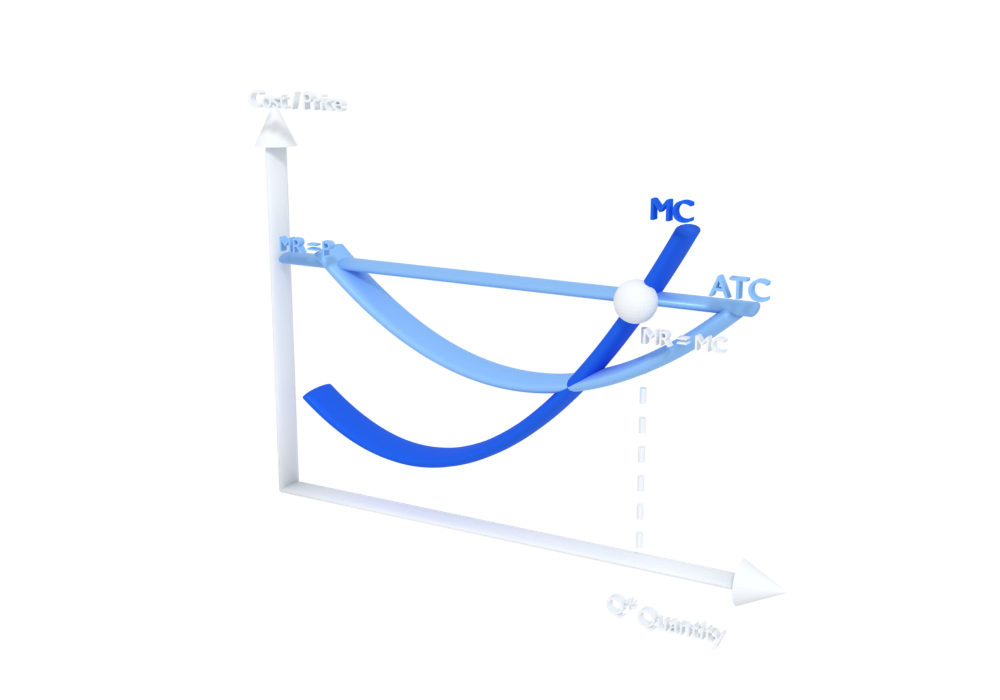
- Analyze firm cost structures: fixed vs. variable, average vs. marginal costs, by building a cost table and graphing the cost curves and the points where they intersect.
- Determine profit-maximizing output under perfect competition, monopoly and oligopoly by setting marginal revenue equal to marginal cost and comparing the resulting prices and profits.
- Apply basic game theory: Nash equilibrium and dominant strategies, by solving payoff matrices for simultaneous-move games such as pricing and advertising choices.
- Identify and evaluate price-discrimination tactics (first, second and third degree), such as student fares, volume discounts and tiered plans, for their effect on profit and consumer welfare.
- Explain externalities, public goods and corrective policies (taxes, subsidies, quotas, tradable permits) and compare their cost and effectiveness in a worked example.
- Explain short-run vs. long-run equilibrium in perfect competition, showing how entry and exit drive economic profit to zero and price to the minimum of average cost.
- Compare monopoly pricing, natural monopoly and related deadweight loss, and explain why regulators consider average-cost or marginal-cost pricing for natural monopolies.
Syllabus
Module 1How Consumers Choose3 hours
Utility and marginal utility · equal marginal utility per dollar · budget line · indifference curves · best bundle · individual demand curve
- Utility and diminishing marginal utility
- Spending a fixed budget with a utility table
- Case: why the second coffee is worth less
- The budget line — what you can afford
- Indifference curves and the marginal rate of substitution
- Finding the best bundle on a graph and in a spreadsheet
- Income and substitution effects of a price change
- Deriving an individual demand curve
- Case: one commuter facing a higher bus fare
Module 2Elasticity and Who Pays3 hours
Price elasticity · midpoint method · total revenue · income and cross-price elasticity · tax burden · deadweight loss
- Price elasticity of demand and the midpoint method
- Supply elasticity and total revenue in a spreadsheet
- Case: a shop deciding whether to cut its price
- Income elasticity — normal and inferior goods
- Cross-price elasticity — substitutes and complements
- Case: classifying a store’s goods from sales data
- Tax and subsidy burden — who really pays
- Calculating each side’s share and the deadweight loss
- Case: a sales tax on a common good
Module 3Production and Costs3 hours
Total, average and marginal product · diminishing returns · fixed and variable costs · average and marginal cost · economies of scale · long-run average cost
- Total, average and marginal product
- The law of diminishing marginal returns
- Case: adding staff to a small bakery with one oven
- Fixed, variable and total cost
- Building a cost table and graphing the cost curves
- Case: where the cost curves meet in a small workshop
- Returns to scale — increasing, constant and decreasing
- The long-run average cost curve
- Case: when a growing factory gets too big
Module 4Profit and the Firm’s Decision3 hours
Marginal revenue and marginal cost · profit peak · break-even · shutdown point · short-run and long-run equilibrium · zero economic profit
- Marginal revenue and marginal cost, unit by unit
- Why profit is highest where MR equals MC
- Case: how many jobs should a small firm take?
- Break-even — price against average total cost
- The shutdown point — price against average variable cost
- Case: a café in a slow season
- Short-run equilibrium in perfect competition
- Entry, exit and the long-run equilibrium
- Case: a crowded market with easy entry
Module 5Monopoly and Market Power3 hours
Monopoly pricing · deadweight loss · natural monopoly · regulated prices · price discrimination · monopolistic competition
- Monopoly pricing, output and deadweight loss
- Natural monopoly: average-cost and marginal-cost pricing
- Case: regulating a water or electricity network
- The three degrees of price discrimination
- Student fares, volume discounts and tiered plans
- Case: judging a tiered plan for profit and welfare
- Product differentiation and short-run profit
- Long-run zero profit and excess capacity
- Case: a street of restaurants against a farm market
Module 6Oligopoly and Strategy3 hours
Payoff matrices · Nash equilibrium · prisoner’s dilemma · repeated games · cartels · comparing market structures
- Games, payoffs and dominant strategies
- Nash equilibrium in simultaneous-move games
- Case: a pricing game and an advertising game
- The prisoner’s dilemma among rival firms
- Repeated games and why cartels form
- Case: why cartels tend to break down
- Perfect competition: setting MR = MC at the market price
- Monopoly and oligopoly: setting MR = MC
- Case: comparing price and profit across three structures
Module 7Labor, Information and Behavior3 hours
Marginal revenue product · wages and employment · adverse selection · moral hazard · framing and loss aversion · default effects
- Labor demand and marginal revenue product
- Labor supply and the competitive wage
- Case: how many workers should a small firm hire?
- Asymmetric information, adverse selection and moral hazard
- Insurance, used goods and lending as examples
- How markets respond: signals, screening and contract design
- Why real choices depart from the rational consumer
- Framing, loss aversion and default effects
- Case: using a default and a frame in a sign-up form
Module 8Market Failure and Policy3 hours
Excludability and rivalry · private, public, club and common goods · externalities · taxes and subsidies · quotas · tradable permits
- Excludability and rivalry
- Classifying real goods: a street, a park, a gym, a fishery
- Matching each market failure to a policy
- Externalities and public goods: why markets fall short
- Corrective tools: taxes, subsidies, quotas and permits
- Worked example: comparing four policies
- Choosing a real externality: congestion or pollution
- Designing a corrective policy
- Effects on price, output and welfare
Module 9Putting It to Work: Models and Cases2 hours
Demand, cost and revenue model · profit-maximizing price · what-if tests · pricing and market-entry cases · limits of the model
- Setting up a demand, cost and revenue model
- Finding the profit-maximizing price and quantity
- Testing what-if changes in the assumptions
- Framing a pricing or market-entry decision
- Applying elasticity, cost and market-structure tools
- Where the model can mislead you