
Corporate Finance Fundamentals
Master NPV, IRR and payback period for capital‐budgeting decision making.
- 25 hours
- Stage: University basics
- Language: English
- Voice: English ✔
What you will learn
- Calculate net present value (NPV) for uneven cash flows by discounting each period's cash flow at the required rate and interpreting the sign and size of the result.
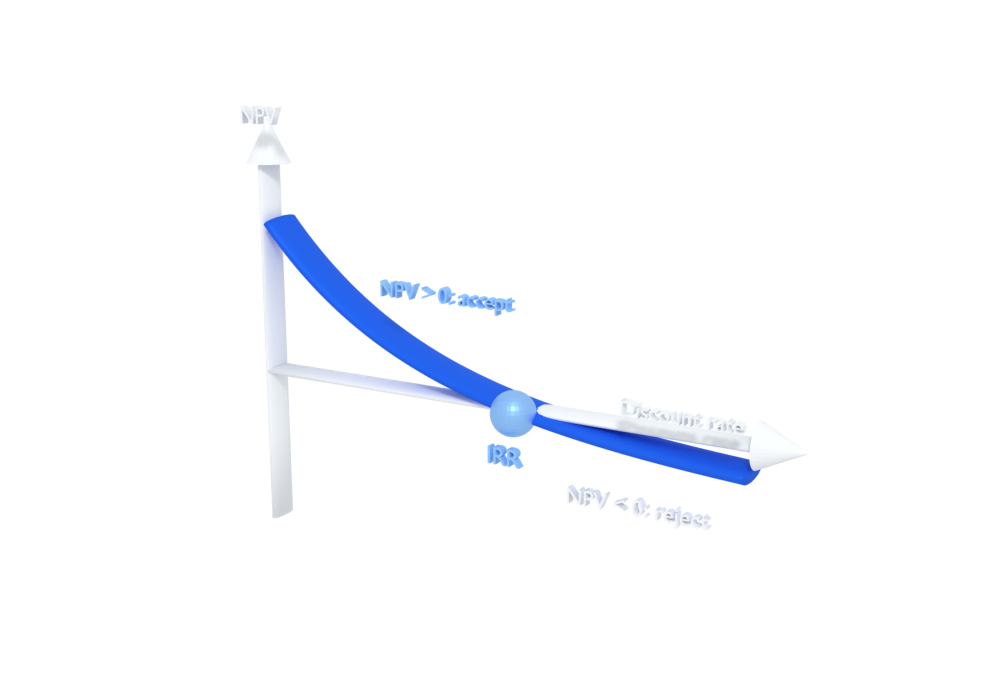
- Compute internal rate of return (IRR) using spreadsheet functions and trial rates, and interpret project feasibility by comparing IRR with the required return.
- Determine payback and discounted payback periods, including partial-year fractions, and explain why neither measure captures value beyond the payback point.
- Compare multiple projects using NPV, IRR and payback criteria, and explain why the criteria can give conflicting rankings.
- Conduct sensitivity and scenario analyses on discount rates and cash flows, identify the assumptions that move NPV most and show the results in tables or charts.
- Incorporate tax effects, depreciation and working-capital changes into incremental after-tax cash flows, including the depreciation tax shield and the recovery of working capital at the end.
- Use decision trees for multi-stage project evaluations by assigning probabilities and payoffs to each branch and calculating expected NPV by rolling back from the final stage.
- Evaluate lease vs. buy decisions under corporate finance logic by comparing the after-tax cash cost of each option, discounted at the after-tax cost of borrowing.
- Align capital budgeting with corporate strategic objectives by linking project selection to strategy, available funds and the organization's capacity to deliver.
- Present investment recommendations with risk-adjusted metrics, stating the decision, the key assumptions and the main risks in a short, clear format for decision-makers.
Syllabus
Module 1Value and the Time Value of Money3 hours
Time value of money · opportunity cost of capital · value additivity · discounting uneven cash flows · reading NPV · choosing the discount rate
- The time value of money: why now beats later
- Opportunity cost of capital and value additivity
- Example: a project that adds wealth for owners
- Discounting one cash flow at a time
- NPV of uneven cash flows in a spreadsheet
- Reading the sign and size of NPV
- What the discount rate stands for
- Picking a rate in practice: the link to cost of capital
- Example: one project at two discount rates
Module 2Building the Cash Flows3 hours
Incremental cash flows · sunk and opportunity costs · side effects · tax and depreciation · working capital · nominal and real rates
- Incremental cash flows: the with-and-without test
- Sunk costs, opportunity costs and side effects
- Example: cleaning a project cash-flow list
- Taxes and the depreciation tax shield
- Working capital: the build-up and the recovery
- Worked example: after-tax cash flows from a template
- Nominal and real: two ways to count money
- Matching cash flows with the right rate
- Example: the mismatch that distorts NPV
Module 3Return and Payback Measures3 hours
Internal rate of return · trial rates and spreadsheets · payback · discounted payback · IRR weaknesses · modified IRR
- IRR: the return built into a project
- Finding IRR with a spreadsheet function
- Example: is the project feasible?
- Payback: how fast the money comes back
- Payback and discounted payback with fractions
- Example: what payback cannot see
- Multiple IRRs and scale differences
- The reinvestment assumption and modified IRR
- Applying modified IRR in a spreadsheet
Module 4Choosing Between Projects3 hours
Ranking by NPV, IRR and payback · conflicting rankings · unequal lives · equivalent annual annuity · profitability index · capital rationing
- Why the criteria can disagree
- Three criteria side by side
- Example: two projects, two rankings
- The problem with unequal project lives
- Equivalent annual annuity and replacement chain
- Example: choosing between two machines
- Capital rationing: when money is limited
- The profitability index step by step
- Example: the best affordable set
Module 5Testing Risk and Uncertainty3 hours
Breakeven points · sensitivity analysis · scenario analysis · tables and charts · decision trees · expected NPV
- Why breakeven points matter
- Calculating breakeven sales
- Example: the sales level where value stops
- Sensitivity and scenario analysis: the ideas
- Running sensitivities on rates and cash flows
- Example: best, base and worst cases in tables and charts
- Decision trees: stages, branches and payoffs
- Rolling back from the final stage
- Example: a two-stage project with a pilot
Module 6Special Decisions and Strategic Fit3 hours
Lease versus buy · after-tax cost of borrowing · real options · delay, expand and abandon · strategy · funds and capacity
- Lease versus buy: the logic
- Comparing after-tax cash costs
- Example: leasing or buying a delivery van
- Real options: delay, expand and abandon
- Why flexibility adds value beyond static NPV
- Example: a project with an option to expand
- Linking projects to strategy
- Funds and capacity to deliver
- Example: a strategy-led project shortlist
Module 7Models, Bias and Recommendations3 hours
Spreadsheet model layout · check cells · forecast bias · incentive conflicts · challenge questions · short recommendations
- Principles of a clear capital-budgeting model
- Building the model in a spreadsheet
- Example: finding an error with check cells
- Forecast bias and incentive conflicts
- Challenge questions for optimistic assumptions
- Example: stress-testing a sales forecast
- What decision-makers need to see
- Risk-adjusted metrics in a recommendation
- Example: a one-page investment recommendation
Module 8Reviews, Cases and the Road to Valuation4 hours
Post-project review · forecast errors · worked case · real-life case · lessons learned · from projects to business valuation
- Why review a project after it is built
- A post-project review template
- Example: tracing a forecast error
- Case setup: replacing equipment and adding capacity
- Case analysis: cash flows, NPV and risk
- Case recommendation: from proposal to decision
- Reading a real capital project case
- Finding what explains the result
- Lessons to apply to your own projects
- From projects to the value of a business
- Cash flows, rate and end value of a business
- Example: from a project NPV to a business value