
Foundations, Initiation, Planning, Execution & Control
Master end-to-end project management—from fundamentals and initiation through detailed planning, execution and control—using both predictive and adaptive approaches.
- 35 hours
- Stage: First job: projects, agile, product
- Language: English
- Voice: English ✔
What you will learn
- Explain project management, its benefits to organizations and the PMI® 12 PMBOK® principles, illustrating each principle with a practical project example.
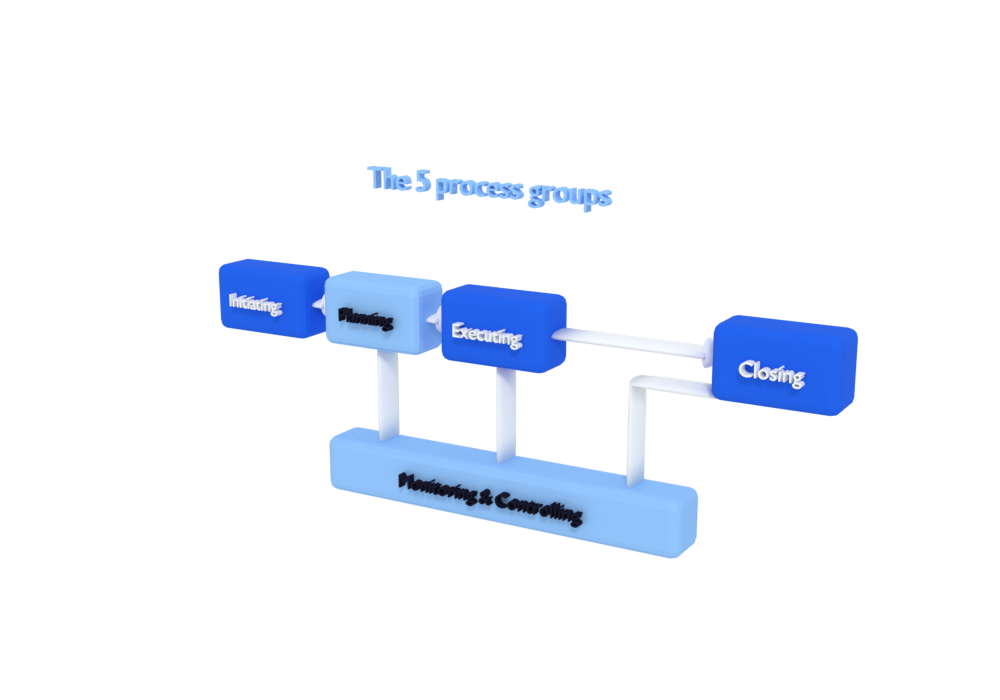
- Compare predictive (waterfall) vs. adaptive (Agile, Scrum, Kanban) lifecycles and the five process groups, and justify which fits a given project's size, uncertainty and constraints.
- Describe the Project Manager’s role, responsibilities, essential skills and career paths across industries, and distinguish them from the roles of sponsor, team member and functional manager.
- Analyze how organizational structure (functional, matrix, projectized) and culture impact project approaches, authority, resourcing and governance choices.
- Contrast project vs. program management methodologies (e.g. PMP/PMI vs. MSP/PgMP), including how benefits, interdependent projects and portfolio priorities are handled at each level.
- Identify common causes of project failure, such as unclear scope, weak sponsorship and poor communication, and select prevention techniques for each.
- Create a team charter outlining roles, norms and working agreements, and hold a kickoff session to gain the team's commitment to it.
- Conduct stakeholder analysis with a power/interest grid and build a stakeholder register, a stakeholder engagement plan and a RACI chart that assign a clear owner to every deliverable.
- Develop initiation documents: Business Case, Project Charter and Project Brief, stating objectives, success criteria, assumptions, constraints and the sponsor's authorization to proceed.
- Lead effective project meetings with clear agendas, decisions and action items, and motivate teams using Tuckman’s model and Five Dysfunctions of a Team.
- Create planning documents: Scope Statement, Work Breakdown Structure, Network Diagram, Schedule (Gantt/Burndown), Budget and Resource Plan, and baseline them so performance can be measured against an agreed plan.
- Evaluate and select project-management tools (e.g. MS Project, Jira, Asana) against team size, methodology, reporting needs and integration requirements.
- Draft support plans (operations, maintenance) and contracting docs (NDAs, RFPs), and define handover criteria and responsibilities for the period after delivery.
- Apply Earned Value Management (planned value, earned value, CPI, SPI), quality planning (standards, assurance, control) and develop Quality & Communications Plans.
- Perform end-to-end risk management: SWOT analysis, Risk Register & Risk Matrix, risk audits & periodic reassessments, and risk-response strategies (avoid, mitigate, transfer, accept), with named owners and triggers.
- Apply data-driven reporting: dashboards, prioritization and storytelling, choosing the few measures that show whether a project is on track.
- Lead stakeholder communications: Communication Plan, public-relations and media essentials, and change-request workflows that log, assess, approve and communicate every change to scope, schedule or budget.
- Plan and run Agile sprints from a Project Manager’s perspective (Sprint Planning, Daily Stand-up, burndown charts, Retrospectives), tracking sprint goals and removing impediments for the team.
- Foster a healthy team environment: empowerment, conflict resolution and sustained motivation, using regular check-ins and feedback to spot and address problems early.
Syllabus
Module 1What Project Management Is3 hours
Projects and routine work · constraints and trade-offs · uncertainty and feedback · the 12 principles · why projects fail
- Projects, constraints and trade-offs
- Uncertainty, feedback and the plan-and-review cycle
- Worked example: a small office move seen through four constraints
- What project management is and what it gives an organization
- The 12 principles and a one-page principles checklist
- Each principle shown in a practical project example
- Why projects fail — the common root causes
- An early-warning checklist for failing projects
- Case: a project that drifted — causes and fixes
Module 2Lifecycles and Methodologies3 hours
Predictive lifecycle · Agile, Scrum and Kanban · five process groups · project, program and portfolio · tailoring
- The predictive (waterfall) lifecycle and the five process groups
- Adaptive lifecycles — Agile, Scrum and Kanban in brief
- Choosing a lifecycle — three projects compared
- Project, program and portfolio — the three levels
- Methodologies side by side — PMI standards and MSP
- Example: one business benefit delivered by three linked projects
- Why one method does not fit every project
- The tailoring note — a one-page template
- Example: tailoring a hybrid approach for a product launch
Module 3Roles, Structures and Professional Conduct3 hours
The Project Manager role · sponsor and functional manager · organization types · authority · professional ethics
- The Project Manager role, duties and essential skills
- Sponsor, team member, functional manager — who does what
- Project manager careers across industries — three examples
- Functional, matrix and projectized organizations
- Authority, resourcing and governance under each structure
- Example: the same project run in a matrix and in a projectized company
- Professional ethics — honesty, fairness and conflicts of interest
- A code-of-conduct checklist for reports and supplier dealings
- Case: a status report that hides bad news
Module 4Initiation: Objectives and Stakeholders3 hours
SMART objectives · success criteria · stakeholder grid and register · RACI · Business Case, Charter and Brief
- SMART objectives and measurable success criteria
- Agreeing deliverables, assumptions and constraints with the sponsor
- Example: turning “a better website” into SMART objectives
- Stakeholders and the power/interest grid
- Stakeholder register, engagement plan and RACI chart
- Worked example: stakeholders and RACI for a system roll-out
- The Business Case — why the project should exist
- Project Charter and Project Brief — templates step by step
- Example: a charter that earns the sponsor's authorization to proceed
Module 5Building and Leading the Team3 hours
Team charter · kickoff session · Tuckman's stages · Five Dysfunctions · effective meetings · motivation and conflict
- Why teams need agreements — roles, norms and commitment
- Writing a team charter — a template walk-through
- Example: a kickoff session from blank charter to team commitment
- Tuckman's stages and the Five Dysfunctions of a Team
- Agenda, decisions and action items — a meeting template
- Example: turning a rambling meeting into a decision meeting
- What makes a team healthy — empowerment and motivation
- Conflict resolution, check-ins and feedback routines
- Example: spotting and fixing a team problem early
Module 6Scope, Planning Documents and Estimates3 hours
Scope statement · Work Breakdown Structure · baselines · scope creep · analogous, parametric and PERT estimates
- The planning documents and how they fit together
- Scope Statement and Work Breakdown Structure — step by step
- Example: baselining the plan of a small project
- Scope baseline and scope creep — how projects drift
- The exclusions list and a simple scope-control process
- Example: stopping a “small extra” request before it grows
- Analogous, parametric and three-point (PERT) estimating
- Estimating durations and costs with a confidence range
- Worked example: a PERT estimate for a three-task job
Module 7Schedules, Resources and Tools3 hours
Network diagram · critical path and float · resource leveling and smoothing · resource calendar · choosing a tool
- Network diagrams and the Critical Path Method
- Float and shortening a schedule
- Worked example: the critical path of a ten-activity project
- Resource over-allocation — leveling versus smoothing
- Building a resource calendar from real availability
- Example: fixing an overloaded team in a schedule
- What a project-management tool should do for you
- Comparing MS Project, Jira and Asana against your needs
- Example: choosing a tool for a ten-person mixed-method team
Module 8Plan in a Tool, Cost and Quality3 hours
Plan structure in a tool · saved baseline · planned and earned value · CPI and SPI · Quality Plan · root-cause tools
- From WBS to dependencies — how a plan is structured in a tool
- Assigning resources and saving the baseline — step by step
- Example: a complete small plan built and baselined
- Earned Value — planned value, earned value, CPI and SPI
- Quality and Communications Plans — templates and standards
- Worked example: reading earned value at month three of a project
- Quality tools — checklists, cause-and-effect and Pareto charts
- Finding a root cause step by step
- Example: a recurring defect traced to its root cause
Module 9Risk, Logs and Procurement3 hours
SWOT and risk register · risk responses · assumption, issue and decision logs · escalation · make-or-buy and contracts
- Risk basics — SWOT, the risk register and the risk matrix
- Risk responses, owners, triggers and periodic reassessment
- Worked example: a risk register for a small project
- Assumption, issue and decision logs — purpose and difference
- Escalation thresholds and named owners — a simple routine
- Example: an issue log that triggers an escalation
- Make-or-buy and vendor selection criteria
- Fixed-price versus time-and-materials contracts
- Example: choosing a vendor with a weighted scorecard
Module 10Communications, Status and Handover3 hours
Communication Plan and public relations · change requests · kickoff meeting · red-amber-green status · handover and support plans
- The Communication Plan and public-relations essentials
- The change-request workflow: log, assess, approve, communicate
- Example: one change request from log to announcement
- Red-amber-green indicators — turning evidence into a rating
- Running a kickoff meeting — agenda and run-sheet
- Example: a weekly status report with evidence behind each colour
- Handover criteria and responsibilities after delivery
- Support plans, NDAs and RFPs — templates
- Example: a handover checklist for a delivered system
Module 11Agile Control, Reporting and Failure Cases3 hours
Sprint planning and stand-up · burndown and retrospective · dashboards · storytelling · failed-project analysis
- Scrum events from a Project Manager's point of view
- Running a sprint — goals, impediments and burndown in practice
- Example: one two-week sprint from goal to retrospective
- Choosing the few measures that show if a project is on track
- Building a dashboard — prioritization and storytelling
- Example: a one-page dashboard a sponsor can read in a minute
- How to analyse a failed project — a method
- Spotting early warning signs in plans and reports
- Case study: a failed project, the missed signs and prevention
Module 12Capstone: The Complete Project Plan2 hours
Case selection · charter to risk register · communication plan · mock sponsor review · link to monitoring, closing and governance
- Choosing the case and mapping the documents
- Assembling the plan — charter, schedule, budget, risks, communications
- Defending the plan in a mock sponsor review
- How baselines, logs and reports feed monitoring and closing
- Governance — the decisions the plan sets up
- Preview: from this plan to Advanced Project Management