
Scrum Master Essentials
Serve teams by running ceremonies, removing blockers and stewarding Agile values.
- 19 hours
- Stage: First job: projects, agile, product
- Language: English
- Voice: English ✔
What you will learn
- Facilitate Sprint Planning, Daily Stand-up, Sprint Review and Retrospective, keeping each event time-boxed, focused on its purpose and productive for the whole Scrum Team.
- Identify, track and remove impediments promptly by escalating the ones the team cannot resolve and making blockers visible on a simple impediment board.
- Coach teams on Scrum values and practices, linking the roles, events and artifacts to the values of commitment, courage, focus, openness and respect.
- Support the Product Owner and Development Team by clarifying accountabilities, helping keep the Product Backlog transparent and ordered, and protecting the team's focus during the Sprint.
Syllabus
Module 1Scrum Foundations3 hours
How Scrum is built · Product Goal, Sprint Goal and Definition of Done · empirical process control · why short Sprints cut risk · the servant leader
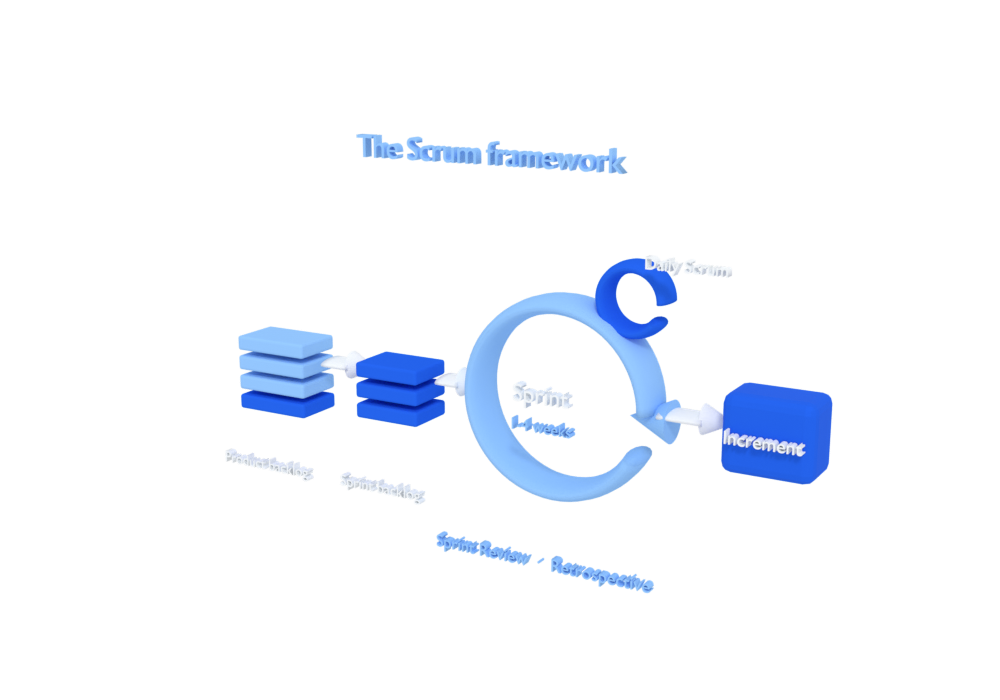
- Scrum on one page: accountabilities, events and artifacts
- Three commitments: Product Goal, Sprint Goal, Definition of Done
- Following one feature through a Sprint
- Empirical process control: see, check, adjust
- Short Sprints versus long plan-driven phases
- Case: finding a wrong turn early, not late
- The Scrum Master as a servant leader
- Scrum Master, project manager and team lead compared
- A day in the life of a Scrum Master
Module 2Working with the Team and the Product Owner3 hours
Accountabilities · supporting the Product Owner · protecting Sprint focus · working agreements · confidentiality and neutrality
- Accountabilities: who owns what in a Scrum Team
- Helping the Product Owner keep the backlog transparent
- Protecting focus: handling interruptions during the Sprint
- Why teams need working agreements
- A workshop to draft a working agreement
- Example: a team agreement on one page
- Neutrality: directing the process, not the work
- Keeping team conversations confidential
- Case: the manager asks what the team said
Module 3Backlog, Goals and Visible Progress3 hours
Backlog refinement · sizing and splitting items · Sprint Goal · Definition of Done · Sprint Backlog · Scrum board in Jira or on a wall
- Backlog refinement: what it is and why it matters
- Running a refinement session: clarify, size, split
- Example: splitting one large story into small ones
- Sprint Goal and Definition of Done explained
- Writing a Sprint Goal and a Definition of Done together
- Example: turning a vague goal into a clear one
- The Sprint Backlog and the Scrum board explained
- Setting up a board in Jira or on a wall
- Keeping the board current: a daily habit
Module 4Running the Scrum Events3 hours
Time-boxing · agenda templates · preparation checklist · the four main events · facilitation skills · a first Retrospective
- Time-boxing: why every event has a limit
- Agenda templates and a preparation checklist
- Opening, running and closing an event in person or remotely
- The purpose of the four main Scrum events
- Facilitation skills: questions, pauses and focus
- Walk-through: one Sprint, four events, one facilitator
- Why Retrospectives matter
- Running Start-Stop-Continue step by step
- From findings to one or two tracked improvement actions
Module 5Coaching, Impediments and Team Health3 hours
Scrum values · coaching the team · impediments and escalation · impediment board · team health check · radar chart
- The five Scrum values and what they mean
- Linking roles, events and artifacts to the values
- Coaching in practice: a team that avoids hard topics
- What an impediment is and why it must be visible
- Building an impediment board and tracking it
- Escalating what the team cannot resolve
- Why look at how a team feels
- Running a health check: survey and radar chart
- From the chart to an improvement conversation
Module 6Hard Moments and Growing as a Scrum Master4 hours
Anti-patterns · first responses · Daily Stand-up case · Sprint Goal at risk · renegotiating scope · personal learning plan
- Anti-patterns: what they are and why they appear
- Choosing a first response to an anti-pattern
- Example: new scope arrives in the middle of a Sprint
- The purpose of the Daily Stand-up
- Case study: the Stand-up that became a status report
- Restoring the purpose: a plan for the Scrum Master
- When a Sprint Goal is at risk
- Renegotiating scope without extending the Sprint
- Example: a Sprint hit by a late technical problem
- The advanced skills ahead
- Assessing your own strengths and gaps
- Example: a learning plan for a new Scrum Master