
Discounted Cash Flow (DCF) Valuation
Master Discounted Cash Flow (DCF) valuation: forecast cashflows, select discount rates and compute terminal values.
- 27 hours
- Stage: First job: finance, banking, risk
- Language: English
- Voice: English ✔
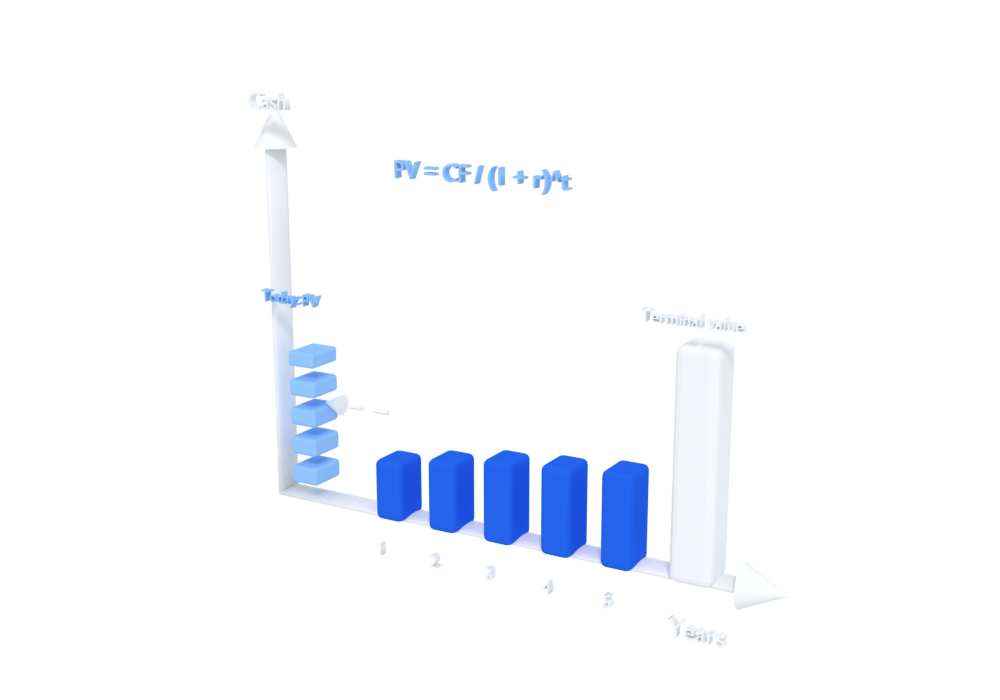
What you will learn
- Forecast unlevered free cash flows (FCFF) and levered free cash flows (FCFE) from revenue drivers, margins, taxes, reinvestment and working-capital needs, and explain when each is used.
- Calculate discount rates using WACC and build cost-of-equity models (CAPM), selecting the risk-free rate, equity risk premium, beta and cost of debt with documented sources.
- Estimate terminal value via perpetual growth and exit multiples, and cross-check each method against the other using the implied multiple and the implied growth rate.
- Construct a three-statement projection that links the income statement, balance sheet and cash-flow statement, and use it to derive cash flows that balance and reconcile.
- Perform sensitivity and scenario analyses on key assumptions, using data tables to show how value changes with discount rate, growth and margins.
- Reconcile DCF outputs with market prices and peer multiples, and explain the gaps through differences in growth, risk or margin assumptions.
- Adjust for non-operating assets and liabilities, such as surplus cash, investments, pension deficits and other debt-like items, when moving from enterprise value to equity value.
- Incorporate tax shields and debt tranches into the model, with repayment schedules, interest calculations and the resulting effect on cash flows to equity.
- Audit model logic using formula tracing, consistency checks, balance checks and independent recalculation to ensure error-free calculations.
- Present DCF results with clear narrative and risk-adjustment commentary, explaining the value range, the main drivers and the assumptions that would change the conclusion.
Syllabus
Module 1Value, History and Revenue Forecasts3 hours
Value as present cash · risk and time · one-off items · steady state · revenue drivers · industry context
- Why value equals future cash, discounted
- Discounting a cash-flow series in a spreadsheet
- Case: pricing a small shop from its expected cash
- One-off items and the steady-state idea
- Normalizing reported results in a template
- Case: cleaning a retailer’s history and fixing the horizon
- Revenue drivers: volume, price and customers
- Building a driver-based revenue forecast in a template
- Case: forecasting a subscription business from its customers
Module 2Building the Cash Flow Forecast3 hours
Capex and depreciation · working capital · FCFF and FCFE · three-statement links · balance checks
- How growth drives capex, depreciation and working capital
- Building capex, depreciation and working-capital schedules
- Case: a growing distributor and its cash tied up in stock
- FCFF and FCFE: what each measures and when to use it
- From revenue to free cash flow in a spreadsheet
- Case: one company, both cash flows side by side
- How the three statements link in a projection
- Linking the three statements in a spreadsheet model
- Case: finding why a projected balance sheet does not balance
Module 3Discount Rates and Beta3 hours
Cost of equity (CAPM) · risk-free rate and risk premium · peer betas · cost of debt · WACC · matching rates to cash flows
- Cost of equity and the CAPM idea
- Choosing and documenting WACC inputs in a template
- Case: working out WACC for a listed manufacturer
- Why beta depends on debt: unlevered and levered
- Unlevering peer betas and relevering in a template
- Case: choosing a peer group for a regional retailer
- Why cash flow and discount rate must match
- A matching checklist for the model
- Case: a valuation that mixed currencies and inflation bases
Module 4Timing and Terminal Value3 hours
Mid-year discounting · stub periods · perpetual growth · exit multiples · implied cross-checks · sustainable growth
- Mid-year discounting and the stub period explained
- Setting up discount factors for mid-year and stub periods
- Case: valuing a company on a date in the middle of its year
- Terminal value: perpetual growth and exit multiples
- Computing both terminal values in a template
- Case: cross-checking with implied multiple and implied growth
- How big terminal value should be and how fast it can grow
- A terminal value test sheet
- Case: a terminal value that carried most of the valuation
Module 5From Enterprise Value to Equity Value3 hours
Net debt · minorities and preferred shares · option dilution · surplus cash and pensions · leases and cyclical earnings
- The bridge from enterprise value to equity value
- Building the bridge and the per-share value in a template
- Case: from enterprise value to a price per share
- Operating versus non-operating assets and liabilities
- Valuing surplus cash, investments and pension deficits
- Case: a company with large cash and a pension gap
- Why leases, stock-based pay and cyclical earnings need a rule
- Recording each treatment choice in the model notes
- Case: the same company with leases treated two ways
Module 6Debt, Tax and Model Structure3 hours
Model layout · version log · debt tranches · tax shields · repayment schedules · circular references
- Why a model keeps inputs, calculations and outputs apart
- Laying out a model template with formatting and a version log
- Case: untangling a model with inputs buried in formulas
- Debt tranches, interest tax shields and cash to equity
- Building a debt schedule with repayments and interest
- Case: a company that refinances part of its debt
- Circular references: why interest on average debt loops
- Iteration switch and fixed-balance approach in a template
- Case: a model that returned errors after a circular reference
Module 7Testing and Stress-Testing the Model3 hours
Sensitivity tables · scenarios · formula tracing · balance checks · independent recalculation · common mistakes
- Why one answer is never enough: sensitivities and scenarios
- Building data tables for discount rate, growth and margin
- Case: reading a sensitivity table for a mid-sized manufacturer
- What can go wrong inside a model: the audit mindset
- Tracing formulas and running balance and consistency checks
- Case: finding a hidden error in a model
- The most common DCF mistakes and why they happen
- A review checklist for catching mistakes
- Case: correcting a flawed DCF model
Module 8Market Check and Presenting Results3 hours
Market prices · peer multiples · explaining gaps · a listed company case · value range · risk commentary
- Why a DCF value and a market price differ
- Comparing DCF output with peer multiples in a template
- Case: a DCF value below the market price
- How to compare a listed company’s DCF with its market
- Gathering public data and listing the assumptions
- Case: which assumptions explain the difference
- Telling the story of a valuation
- Building a valuation summary page with a value range
- Case: naming the assumptions that would change the conclusion
Module 9Judgment and the Full Model3 hours
Honest assumptions · choosing a method · relative and startup valuation · full model build · comparison with market value
- Why honest assumptions matter more than a neat answer
- An assumptions log with sources and reasons
- Case: a valuation nudged to hit a target price
- DCF, relative and startup valuation compared
- A method-selection guide by stage, data and purpose
- Case: valuing a mature company and an early startup
- Planning the full model from published statements
- Building the DCF in the spreadsheet template
- Case: comparing the finished model with market value