
Finance & Investment for Leaders
From the first term to the boardroom — every finance idea in plain words, with live examples you can touch.
- 25.5 hours
- Stage: University basics
- Language: English
- Voice: English — coming soon
What you will learn
- Explain how any company turns money into a product and back into money
- Tell revenue, cost and profit apart in any report
- Say why profit and cash are not the same thing
- Read each of the three reports line by line
- Follow one sale through all three reports
- Know what the auditor’s opinion is warning about
- Work out the 10 ratios boards use most
- Judge if a company can pay what it owes this year
- Spot warning signs in a set of accounts
- Explain why a profitable company can still run out of cash
- Measure how many days cash is stuck in the business
- Read a 13-week cash forecast
- Find the break-even point of any project
- Read a budget-vs-actual report and ask the right question
- Choose the 5 KPIs that matter for a company
- Explain why one pound today is worth more than one pound next year
- Compare cash now with payment in instalments
- Show how inflation eats into returns
- Read a feasibility study and find its weak assumptions
- Decide using NPV and IRR
- Test “what if sales come in 20% lower?”
- Explain the 3 main ways to value a company
- Move from the company’s value to the owners’ value
- Challenge a valuation report with 5 questions
- Explain each investment type, its return and its risk
- Know who supervises what in Egypt’s market
- Read a stock market page
- Name the 6 main risks of any investment
- Show why spreading money lowers risk
- Read a risk register and heat map
- Compare borrowing with selling shares for a project
- Explain the cost of capital in plain words
- Read the key lines of a term sheet
- Read a holding’s consolidated report and see which company makes cash and which one eats it
- Ask the 10 board questions that matter
- Judge an investment memo and a due diligence report
Syllabus
Module 1The Language of Money2 hours
How a business earns and spends · revenue, cost, profit · profit vs cash · the money loop
- How a business makes money — the money loop
- Revenue — the money coming in
- Costs — direct costs and running costs
- Profit — gross, operating and net
- Profit is not cash
- Reading a number like a leader
Module 2The Three Financial Reports2.5 hours
Income statement · balance sheet · cash flow statement · how they link · notes · auditor’s report
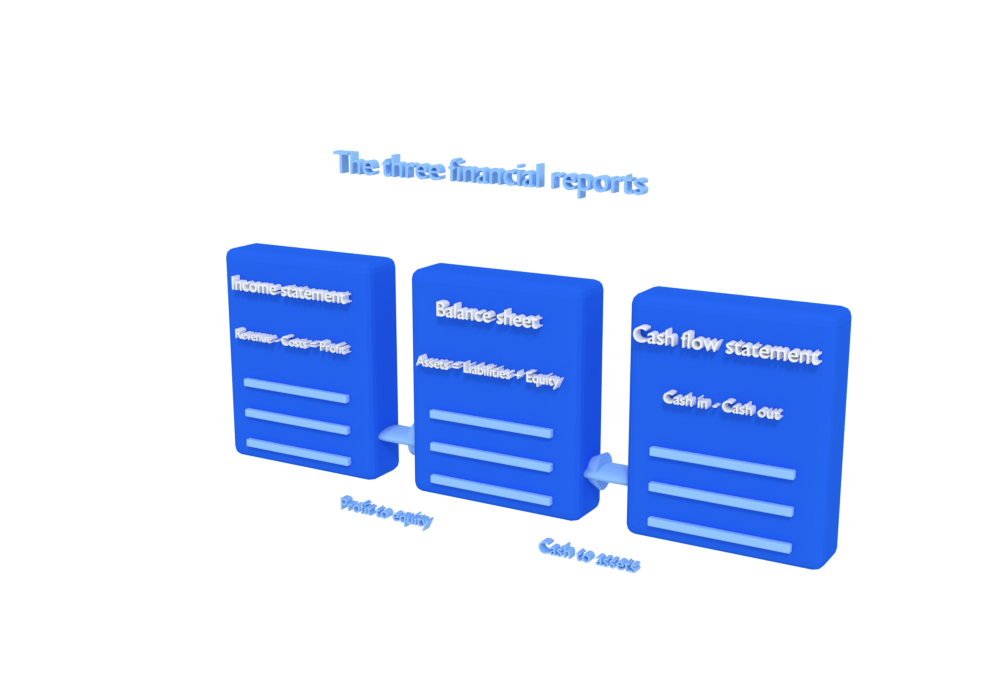
- Why every company keeps three reports
- The income statement, line by line
- The balance sheet — Assets = Liabilities + Equity
- Current and non-current — what turns into cash this year
- The cash flow statement — operating, investing, financing
- How the three reports link
- The notes — where the real story hides
- The auditor’s report
Module 3Reading the Numbers: Financial Ratios2 hours
Margins · liquidity · leverage · efficiency · returns (ROE, ROA) · red flags
- What a ratio is and why boards use them
- Profit margins — gross, operating, net
- Liquidity — current ratio and quick ratio
- Leverage — debt-to-equity and interest cover
- Efficiency — asset turnover, receivable and inventory days
- Returns — ROE, ROA and ROI
- Ten red flags in a set of accounts
Module 4Cash Is King: Working Capital2 hours
Receivables · payables · inventory · the cash conversion cycle · cash burn and runway · cash forecast
- Working capital — cash tied up in daily business
- Receivables — when clients owe us
- Payables and inventory
- The cash conversion cycle
- Cash burn and runway
- Reading a 13-week cash forecast
Module 5Costs, Budgets and Break-even2 hours
Fixed and variable costs · contribution · break-even · pricing · budgets · budget vs actual · KPIs
- Fixed and variable costs
- Contribution margin
- Break-even point
- Pricing — cost-plus and value pricing
- Budgets and budget versus actual
- KPIs — the few numbers that matter
Module 6Time Is Money2 hours
Interest · compounding · inflation · present and future value · discount rate · loans and instalments · currency
- Interest — the price of money
- Compounding
- Inflation and real returns
- Present value and future value
- Loans and instalments
- Currency and exchange rates
Module 7Is This Project Worth It? Feasibility and Investment Appraisal2.5 hours
Feasibility studies · project cash flows · payback · NPV · IRR · sensitivity · scenarios
- Inside a feasibility study
- A project’s cash flows
- Payback period
- Net present value (NPV)
- Internal rate of return (IRR)
- Sensitivity — what if?
- Scenarios — best, base, worst
- Ten questions for any feasibility study
Module 8How Much Is a Company Worth? Valuation2 hours
Price vs value · DCF · multiples (P/E, EV/EBITDA) · asset value · enterprise vs equity value
- Price and value
- Discounted cash flow (DCF)
- Multiples — P/E and EV/EBITDA
- Asset-based value
- From enterprise value to equity value
- Challenging a valuation report
Module 9Where Money Lives: Investments and Markets2 hours
Deposits · T-bills · bonds · sukuk · shares · funds · real estate · gold · who supervises what in Egypt
- Bank deposits and savings certificates
- Treasury bills and bonds
- Sukuk
- Shares and the stock exchange
- Investment funds
- Real estate and gold
- Who supervises what in Egypt
Module 10Risk and Return2 hours
Types of risk · risk vs return · diversification · portfolios · hedging · risk appetite · risk registers
- What risk really means
- Risk and return go together
- Diversification
- Building a portfolio
- Hedging currency and interest-rate risk
- Risk appetite, risk registers and heat maps
Module 11Funding a Business: Debt and Equity2 hours
Bank loans · covenants · leasing · bonds and sukuk · venture capital · private equity · IPO · cost of capital
- Debt or equity — the basic choice
- Bank loans and covenants
- Leasing
- Corporate bonds and sukuk
- Venture capital and private equity
- Going public — the IPO
- Cost of capital (WACC)
Module 12The Holding Company Playbook2.5 hours
Holding structure · subsidiaries · consolidated reports · governance and boards · M&A · due diligence · board packs · investment memos
- How a holding company works
- Subsidiaries, associates and stakes
- Consolidated reports
- Governance — boards, committees, who decides what
- Buying and selling companies — M&A
- Due diligence
- Board packs and investment memos
- Final case — the board meeting